
“You shall love your neighbor as yourself.”
Is it fair to say that we are often not terribly good at this loving our neighbor bit? Weekends like this matter because they bring so many parts of our community together.
Love God and love your neighbor. One cannot love God without loving our neighbors
Loving our neighbor is hard work and we often fail.
How did the Germans integrate with the indigenous people?
The Congregationalists tried to keep the Methodists out of downtown.
The members of this German Church refused to conduct worship in English, shutting out those who did not speak German.
And yet, a town was built, neighbors came together to play baseball, hook rugs, can beans, build electronics, or make Sauerkraut. People gather at Moody’s and at the new Perch Café. People gather in faith communities old and new.
As we celebrate the past, may we also look to the future.
We are a community of differing heritages—from here and away.
In the early days of the American Civil War, Waldoboro people were not all of one mind.
We continue to hold differing political and religious beliefs.
Can we work to build a community where our differences become our strengths? Where discussions about what books should be available to youth can make us all better read and more understanding of our differences and strengths?
Can we work to build a community where our youth learn curiosity, critical thinking and respect for one another?
May we embrace one another with kindness, curiosity, and love.
Let’s take time to listen to one another’s fears and acknowledge our own fears.
Let’s look for the commonality in our political, moral, and social beliefs.
Let’s try to love our enemies.
Scripture says that love casts out fear.
May we in this town—a town that is progressive and conservative—Republican and Democrat, Jew, Christian, Buddhist, and more work together in love and harmony.
May we bridge the gaps between class and neighborhood, between old and young.
May we work together, play together, learn together, dream together, and laugh together.
May we respect one another’s prayers.
May we honor this land of our ancestors and our descendants.
May God’s love open our hearts wider and wider. Amen.
 revnancyduncan
Very nice … I’ve attached my sermon from last Sunday that preaches similarly …
Peace,
Alan
SERMON Sheep in the midst of wolves Rev. Dr. Alan Baughcum
Sheepscott Community Church, Newcastle ME, 6-18-23, Ex 19:2-8a, Mt 9:35-10:23
Prayer: O Lord, may the words of my lips …
I like to let the congregation know what the sermon is about pretty early in the sermon. I also like to let the congregation know what I expect all of us to about the subject of my preaching clearly and early. So, here it is …
We live in a world that seems intent on fracturing itself into increasingly small and evermore intense groups of believers … left-wing politicos, right-wing politicos, Second Amendment loyalists and anti-gun crusaders, same with abortion, same with racial issues, the list goes on and on. Everything has been politicized: sex, race, sports, etc. It is important in times such as these to hold onto to what is central to our faith. What is central is our belief in and our relationship with a loving and sovereign God whose Kingdom has come near and will be established in full. More than that, we believe and are guided by the belief that God has work for us to do in the interim. Focusing on what is central to our faith will help us navigate the treacherous waters of modern political and cultural divisions.
In the membership liturgy we employed just a few minutes ago, we all acknowledged that we are on a journey together. Well, the newly freed slaves were also on a journey, from bondage in Egypt to a mountain in the Sinai Peninsula to meet with God. Thence they journeyed to the promised land.
That journey was rough … terrible heat, lack of water, insects and creatures that stung and bit and killed with venom, confusion about direction, and violence from tribes along the way. What got them through? Well, it was their covenant with God and the providential leadership of Moses and Joshua that got them through.
In Matthew Jesus sent out his disciples on a journey. And it was a very tough journey. Jesus would not let the disciples take anything with them. In the words of Blanche Dubois in Streetcar Named Desire, they were to depend on the kindness of strangers for food and shelter. What did Jesus give them to see them through? Jesus told them to proclaim the good news of the Kingdom of Heaven, the very embodiment in community of the Ten Commandments that God gave Moses and Moses gave to the people at Mt. Sinai.
The thing that got the Hebrew people to the promised land was their covenant with God as expressed in the Ten Commandments. The thing that got the disciples through their assignment was the covenant with God made real in God’s Kingdom, come near in Jesus and to be established in full.
Now it is our turn. What is going to get us through our journey? It is the great God about whom John preached last Sunday. Our God does not reside just on top of Mt. Sinai. Our God does not live within the boundaries of ancient Israel or Judah. Our God is the author of all that is seen and unseen. More than that, our God through the Holy Spirit goes with us on our journey.
There are a lot of similarities between our journeys and the journeys on which Jesus sent the disciples.
Jesus sent his disciples out among people who lived by subsistence agriculture. They mostly ate bread, mostly barley bread. They supplemented that with small amounts of local fruits (figs, for example) or vegetables, oil, and salt. Unless you lived near the ocean or a lake, fish was rare. And meat, say, lamb for example, was even rarer.
We are going out into a very sophisticated economy. We are going out into a very well-fed, perhaps overfed, population with a very diverse pantry. It is a very different world than the one facing Jesus’ disciples. However, like them, if we are to make a dent in the culture, we too depend on the kindness and good nature of those to whom we bring the message of Jesus and the good news of the Kingdom. We must be smart enough and loving enough to appeal to people’s better selves without alienating them with bombast and dogma.
Another similarity: both Jesus’ disciples and we face the dangers of those who would use violence to achieve their ends. The Zealots of Jesus’ days were prepared to kill to drive the Romans out of their land. And the land was full of bandits and criminals who made transportation and commerce and even daily living dangerous. We face similar problems, with violent elements on both ends of the political spectrum plus jihadists intent on terrorism, although we in Maine probably face less of that than most places in the world.
Both we and the disciples face a society with deep divisions. In Jesus’ time, Judaism was divided between Sadducees, who controlled the Temple in Jerusalem, the Pharisees who had their own notions of what the Jewish faith should be, the Essenes, mostly ascetics who lived by themselves in the deserts, and Samaritans who lived in the north and were rejected by other Jews because, among other reasons, their lineage had been polluted, as non-Samaritan Jews saw it, by intermarriage with other non-Jewish peoples. And that does not count the ruling Romans and their hangers-on.
Ours is also a deeply divided world. Educated people are contemptuous of the uneducated and the uncredentialed, while the latter do not think that the educated look out for any interests other than their own. Rich people live very different lives than the non-rich, and the non-rich do not trust the rich. Coastal elites disdain people who live in the vast interior of our country, and folks from the interior take a very jaundiced view of the lifestyles and decision-making of the east coast and west coast powerful.
Now is the point in this sermon when I am supposed to share with you what we should do about all these problems. Good luck to me!
As I have warned you before, this sermon, as with most of my sermons, is really directed at myself. Feel free to listen in on some of the things I keep telling myself.
First, as important as the various issues of the day are, they are penultimate … they are not ultimate. Only God is ultimate. If we are so focused on a particular issue that we forget about God and God’s plan for all of Creation, including that portion of God’s creatures that disagree with us, then we are off base. We need to re-center on God, and to remember how Jesus distilled the essence of the Ten Commandments and of our covenant with God … love God, love neighbor … especially those that are so dad-blasted wrong-headed about the issues I really care about!
Second, we need to be careful in our loving that we do not harm one another. The fact that I think someone is very, very wrong on a particular issue or in supporting a particular candidate is no excuse for mistreating them. Nor is it an excuse for authorizing those in power to bend the institutions of justice in my favor or against them. We are all children of God, and the administration of justice needs to be even-handed.
Third, we need to remember that we might be wrong. I grant you that I am not wrong very often, well, hardly ever. But it does happen. I, and we, need to entertain the idea that our notions may be in error. We need to entertain the idea that conversation with those that disagree with us might help us come to a different conclusion, or a better idea. We need to
be modest in insisting on our way. And, brother, I can talk for hours about how modest I am … but that is another sermon.
Finally, if we have centered ourselves, and if we have established a framework that is fair to all parties and if we have engaged in discussions with those who differ, and we still have an idea or an opinion that is loving and makes good sense, we should share. The Greek root for the word “idiot” is someone who stays silent in the marketplace of ideas. Mere politeness should not silence us … we need to speak out about our deeply held ideas and beliefs.
The only way we are going to get through this time of trial is to keep our eyes focused on what is ultimately important … our loving and sovereign God and God’s plan to bring peace and justice and healing to God’s Creation. We do that, at least in part, by not harming each other, by being modest about our own certitude, by making an effort to find common ground with those with whom we disagree, and by speaking out in love.
Let us pray: Loving and sovereign God, thank you for you care for your Creation. Thank you for the gift of your Son who showed us how to live. Thank you for the gifts of love, peace, and reason that enable us to work with one another and to listen to one another and to speak to one another in ways that are constructive and consistent with your providential plan. Send your Holy Spirit to help us do all these things and to work in anticipation of your coming Kingdom. Amen.
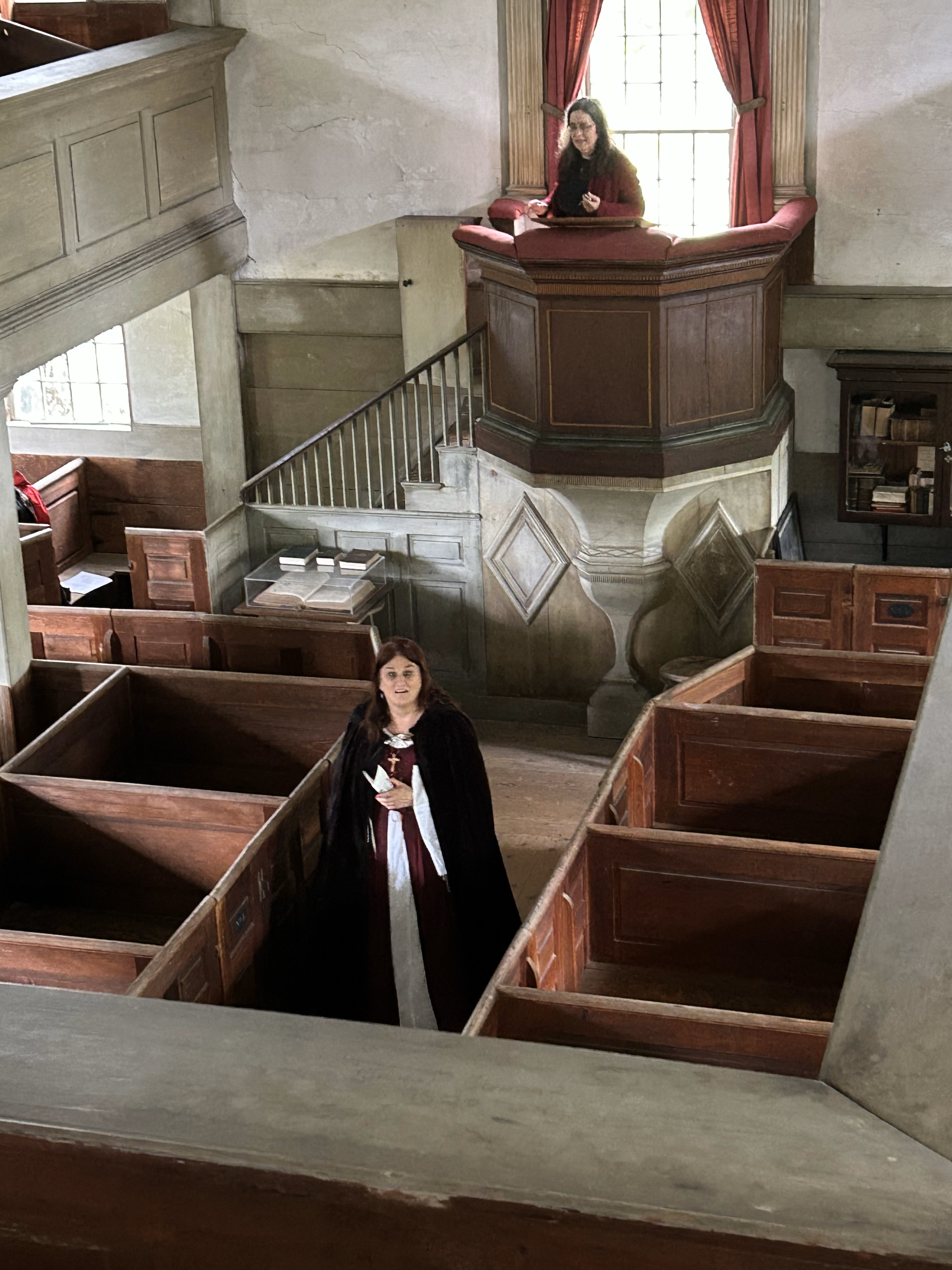
Thank you for sharing this, Nancy. Your message in the Old German Church on Sunday was so moving and full of love; a message we all need to hear again and again.
Thank you, Nancy for sharing this. Your sermon on Sunday at the Old German Church was moving and filled with love and words to live by. Your words are a gift to all who are fortunate enough to hear them.