Sunday worship and social distancing

Then Jesus began to speak to them in parables. “A man planted a vineyard, put a fence around it, dug a pit for the wine press, and built a watchtower; then he leased it to tenants and went to another country. When the season came, he sent a slave to the tenants to collect from them his share of the produce of the vineyard.  But they seized him, and beat him, and sent him away empty-handed. And again he sent another slave to them; this one they beat over the head and insulted. Then he sent another, and that one they killed. And so it was with many others; some they beat, and others they killed.  He had still one other, a beloved son. Finally he sent him to them, saying, “They will respect my son.’  But those tenants said to one another, “This is the heir; come, let us kill him, and the inheritance will be ours.’  So they seized him, killed him, and threw him out of the vineyard. What then will the owner of the vineyard do? He will come and destroy the tenants and give the vineyard to others.  Have you not read this scripture: “The stone that the builders rejected has become the cornerstone;  this was the Lord’s doing, and it is amazing in our eyes’?”  When they realized that he had told this parable against them, they wanted to arrest him, but they feared the crowd. So they left him and went away.   Mark 12:1-12

This parable is hard.  Shutting down our in person corporate worship is hard. Worrying about illness and toilet paper, the stock market, stocking up on food and wondering where and when the virus will pop up next is hard.  Checking in with coronavirus news, other clergy, and trying to learn how to use digital media is hard.

Jesus told a story about a man who planted a vineyard, put some capital into it and leased it to tenants.  Were the terms of the agreement with the tenants fair?  We don’t know.  The landowner sent a slave to collect the landowner’s share of the produce and the tenants beat him up.  And then the landowner sent another slave who was also assaulted. And a third slave. And then his son and they killed the son.

Get where this is going?  Jesus was sharing this story with the religious leaders and they realized it was critical of them and they wanted to arrest Jesus.

Sadly this parable has been used to condemn the Jews but that is wrong.  Aren’t we often the religious leaders/tenants thinking that if we are given a vineyard to manage that it is all ours?  Where is the injustice or duplicity in this story? My great grandmother spoke of stocking up on sugar in the midst of a shortage; she wanted to get it before the hoarders did.  Hum….   (And this morning I purchased a package of toilet paper when I normally would have waited a few more weeks.)

Where is the injustice in this story? The landowner put his capital and labor into the vineyard and the tenants killed his son. Where is the injustice in our own lives?

We are faced with choices.

Will we respond to the Coronavirus with love?  Will we care for oneanother with our open hearts? Will we share the food or toilet paper?  Will it feel like the church is shut down—absent when we most need it?  Or will the people of God at the Broad Bay Church rise to the challenge of protecting our community by washing our hands and physically distancing ourselves from one another while praying together, calling one another and strengthening our connections in this time?

I know that some of you are losing your most important outing of the week—gathering at Broad Bay where you will be greeted by name by people who may have known you for years.   I know that we will all miss the adventure of worship where the spirit surprises us with joy and wonder.  I know we will miss following the stations of the cross and hearing what Caroline Bond has to say.  I know that there is something so powerful about being reminded that “God loved you then, loves you now and will love you always.  God is always inviting us back to Godself.  We are forgiven.  Thanks be to God.” I can feel the power of inviting you to share your joys and concerns.

Our response to this crisis will have long term impacts on our church and our community.  Will we come together across the political and religious boundaries that divide us and love our neighbor and love God with all our heart, soul, mind and strength? Will we reach out into the community with phone, letters, and offers to help and to be helped? Will we feel the love and power of God as reflected through this community of faith today and in the days to come?

We are not closing the church.  We are learning how to do church differently so that we can protect ourselves and our community.  If we can “flatten the curve” and slow the spread of COVID 19, we can help to save lives. Call a friend.  Pick up the church directory and contact someone you haven’t seen.  Have a long heart to heart talk or a short conversation about the weather.  And don’t forget to mail your contributions to Broad Bay Church at PO Box 161, Waldoboro, 04572.

My prayer and my belief is that the people of the Broad Bay Church will rise to the challenge.  God, Jesus, and the Spirit are with us. May we find joy and peace.

Please contact me at 207 691-1036 or broadbayucc@gmail.com.  Let me know how you are doing. Let me know what you need whether prayer or food.  Above all, let us love God and our neighbor.


Posted in Uncategorized | Tagged | Leave a comment

Being Church–Covid19

3/13/2020COVID19Announcement

Here is the video announcement that we are social distancing and my attempt to learn new ways to communicate.   See my attempt to self-video while on a walk to Rockland Harbor.   Let me know if you can actually view it and if you actually enjoy hearing from me in this way.

God is with us.  You are loved.  We will walk together.

Posted in Uncategorized | Tagged | Leave a comment

A Place for All

This poem appeared in my life as I’m dreaming about post construction programming at the church.  Soon the construction will be over and we’ll have an accessible sanctuary with accessible bathrooms all set on a firm (at least under the steeple area) foundation.  How will we live out our call to be A Place for All?

Could it be that one of the important things for us to do is to provide a place for people of all faiths and no faiths to gather in a sacred and quiet place with music and poetry, readings and prayer?

One of the things that Jesus taught was to create clearings in the busyness of daily lives as he sat and ate with those on the margins?  And when the crowd was closing in on him, he often went alone to pray.

The Clearing

Do not try to save
the whole world
or do anything grandiose.
Instead, create
a clearing
in the dense forest
of your life
and wait there
patiently,
until the song
that is your life
falls into your own cupped hands
and you recognize and greet it.
Only then will you know
how to give yourself to this world
so worthy of rescue.

Martha Postlewaite

Posted in Uncategorized | 5 Comments

Interruptions

Interruptions.

Jesus was on his way to heal Jairus’s critically ill 12 year old daughter when he was waylaid by a woman who had suffered for 12 years and was considered unclean. She grabbed his cloak and was healed.  (Mark 5:21-43).

Jesus was interrupted. He still healed but instead of only healing the daughter of a respected man, he turned to the unclean woman who grabbed his cloak and she was healed as well. Jesus accepted the interruption and expanded his healing ministry.

Could it be that it is the interruptions, the surprises, that carry us forward? Strategic planning is important but sometimes the interruptions expand our vision.  Sometimes the interruptions show us alternative paths.

One of the most beautiful and transformational healing stories occurred as Jesus was on his way to someplace else.

Let’s pay attention and celebrate the interruptions that lead us closer to God’s abiding love.


Posted in Uncategorized | 1 Comment

Ears to Hear–Sermon preached 1/26/20

Mark 4:1-34

And those who could hear heard.

Jesus implored his disciples to listen. Listen.

The sower sows seeds with abandon, with grace and those who hear, hear. Seeds are sown everywhere.

Martin Luther King.  Stood for so much: Justice, equality, peace.
His tools:

  • Scripture.
  • God’s love.
  • Non-violence.
  • Deep discipline.
  • Roots that grow deep into the soil, the soil that has been fertilized for generations.
  • Leaders of the non-violent civil rights movement of the 50s and 60s revealed the hatred in our land with their love. Eating together, black and white, elicited violence. Or revealed violence.

Martin Luther King Jr. stood firm with roots deep in the soil of God.  Stood on the faith of our fathers and mothers. Told the truth about racism and war and injustice sowing the seeds of love.

For those of us who believe in reconciliation, who believe in truth telling, who believe that there are values that bind us together as as Christians and Americans, it has been a hard week. For those who believe that the values that bind us transcend partisan politics, it has been a hard week.

A short video appeared on my facebook feed from The Atlantic from March 2018, a song sung by Joan Baez, When the President Sang Amazing Grace. https://www.youtube.com/watch?v=m9iYBifsOPI

I returned to the video of the funeral of Reverend Clementa Pinckney in 2015.  I watched as a community gathered in sorrow over the killing of 9 people in a Mother Emmanuel Church because of the color of their skin.  In that moment a community gathered in grief and love—white and black. President Obama went to the pulpit and spoke.  His first words: “To God be the Glory.” That day, it was easy to know and believe that we would come together as people of God, as Americans, and break down the barriers between us with love–with Grace.  Gathered to honor, to recognize, to mourn our history of violence against African Americans (and might I add Native Americans and Japanese Americans).

When there are no words – when evil seems to be ascendant, we are called to sow God’s seeds, to bear God’s light, to sing Amazing Grace throughout the night.

Today, I endeavor to stand with the sower. To sow seeds with wild abandon. To look for a way to share the love. To be the light. To listen for God’s word.

Byran Stevenson of the Equal Justice project and author of Just Mercy believes it is critical that we build a narrative around what happened in our nation around slavery and lynching—the narrative that says that Africans are an inferior people. There are no memorials to Nazi leaders in Germany and that when they visited there a political leader said that after the holocaust, they do not have the moral authority to use the death penalty. In the US there are memorials to those who slaughtered native peoples; there are memorials to those who fought to maintain the institution of slavery.

So Bryan Stevensen, step to work to create memorials. As part of the lynching memorial, in Montgomery, they invited people to take a jar and collect dirt from the nearly 4000 places where there were documented lynching; they invited people to go to the places where lynching occurred and dig up some dirt to return to the memorial. A black woman was both scared and determined as she went to a field with trowel and jar.  A white man drove by, stopped, asked her what she was doing. Afraid, she surprised herself and told the truth.  He asked to read the brochure about the project and then asked to help.  As they filled the jar, he started to shake. “Are you ok?” she asked.

“No” he responded.  “I just hope it wasn’t my granddaddy or great granddaddy who did this.”

Together they brought the dirt back to the lynching memorial.

She was terrified.  But told the truth.  The truth that could have hurt her.  But reconciliation occurred. God is still sowing seeds.
To hear Bryan Stevenson’s interview with Terry Gross:
https://www.npr.org/2020/01/20/796234496/just-mercy-attorney-asks-u-s-to-reckon-with-its-racist-past-and-present

We are called to sow seeds and to be in ministries of reconciliation—not run from the truth but to stand in the light and love of God.

God gives us ears to hear.  To listen to the hurt and fear in another.  To find the place of common ground. To be just in all things.

Jesus said to them, “Is a lamp brought in to be put under the bushel basket, or under the bed, and not on the lampstand? For there is nothing hidden, except to be disclosed; nor is anything secret, except to come to light. Let anyone with ears to hear listen!”

Listen. Watch. Sow seeds of love and justice. Amen.

Posted in Uncategorized | 2 Comments

Blowing In the Wind

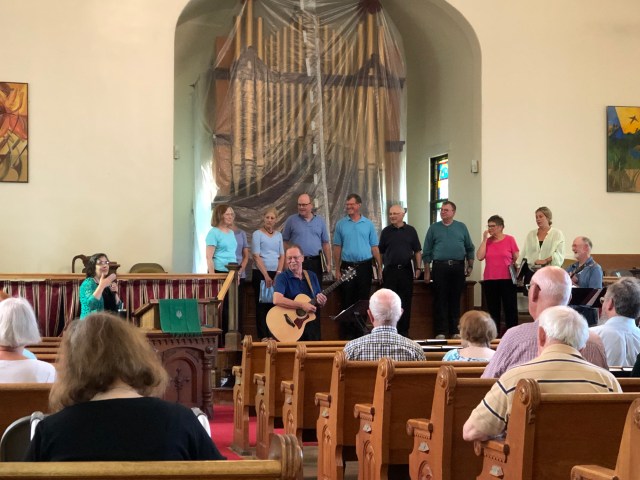
On Sunday, June 21 the Hingham Singers came to Broad Bay. 2019.HinghamSingersAs they were just off a concert tour focused on the music of Peter, Paul and Mary, I focused on Bob Dylan’s song, “Blowin’ in the Wind.”  It was part of a series on Renouncing Violence.  What do we do when we feel surrounded by violence and in the desert of dry bones?   See sermon below.

Singer song writer Carrie Newcomer, said, “I am not part of the resistance.  I am part of creating a kinder and gentler world.”

Pete Seeger’s bango said, “This machine surrounds hate and forces it to surrender.”

The music of Peter, Paul and Mary opened hearts in a time of national conflict, crisis and change.  Vietnam, civil rights, Kent State, the draft.  Churches were split. Families split.  Leaders assassinated.

Peter, Paul and Mary and many others sang.  They brought us together to sing.

Yes, ‘n’ how many years can a mountain exist
Before it’s washed to the sea?
Yes, ‘n’ how many years can some people exist
Before they’re allowed to be free?
Yes, ‘n’ how many times can a man/woman turn his/her head
And pretend that he/she just doesn’t see?
The answer, my friend, is blowin’ in the wind
The answer is blowin’ in the wind.  Bob Dylan

“How long, O lord?”  the psalmist cried.

“How long, O Lord?” the prophet cried.

“How long, O Lord?” the people cry.

“How long, O Lord?”

The answer is blowing in the wind.

So often the wind is where we glimpse God—in that which is felt but unseen, through the Holy Spirit the third person of the trinity.

Sailors learn to read the wind by looking at the waves on the water.  Their ability to arrive safely at their destination, is dependent of their ability to read the wind. We know God by the signs we see as the winds of the spirit blow, as the spirit does her playful and creative dance.

These days, as I read the paper (no, read my phone) and pay attention to the news, my heart breaks and I don’t know how to find the way forward. It is so tempting to rage.  There is no five point plan to bring love and justice and mercy.  There is showing up and looking for an answer in surprising places.

Jesus said, “The wind blows where it chooses, and you hear the sound of it, but you do not know where it comes from or where it goes. So it is with everyone who is born of the Spirit.”  John 3:8

We know the places of dry bones.   As churches decline and become less relevant in the wider culture, it can feel like we are surrounded by dry bones.  But we know we are a resurrection people.

We know the place of dry bones, a place of fear or helplessness from which there is no way out.  And yet… we are a resurrection people.

We know the place of dry bones—where violence is everywhere.  Where our rhetoric is disrespectful at best, and hate-filled and inflammatory at worst.

We know the place of dry bones and we are resurrection people.

Perhaps my greatest qualification to be your pastor in this time and place is that I spent two decades before I came here working with folks on the edge in the valley of dry bones: homeless women, psychiatric patients, families with a child at risk of removal.  At first I was green and had no idea of what to do.  Later, I still had no idea of what to do but learned to lean in to the unknown and look for the glimpses of hope. When anger or violence reigns, when tempers are high, when people are hurting and discouraged, when people have come to expect the worst, when trust is broken, ordinary resources do not work.

The only tool I had when a drunk angry woman was pushing another, was companionship.  A conversation, a joke, a cup of coffee.

Working with families at risk, problems were seldom solved by focusing on the problem.  Why is Johnny so upset with his parents?  Focusing on the misery of the situation, the precursors to the outburst, is important but often leads to more misery.  Instead it is more effective, or at least more rewarding, to throw caution to the wind and search for the times/moments when Johnny was calm.  What was happening?  Is there something to be learned from a day that went well?  Listen and watch for the sounds of laughter.  Listen and watch for times of cooperation.

It may feel like all sense of civility and decency has left our politics.  When tempers are this high and positions dug in this firmly, I despair.  When tempers are high and accusations running hard, it seems that violence or words with hard edges are the only way; And yet, does that help?

The non-violent civil rights movement found a way.

The arts lead us in other ways.

The Holy Spirit invites us to keep our eyes open for changing conditions, for a new way to our destinations.

Caring for a special needs child, an adult or elder with a chronic illness, resolving intractable societal problems, or any other challenge, demands that we follow the God who is in the winds.

There is an old hymn:

Give to the winds thy fears;
hope and be undismayed.
God hears thy sighs and counts thy tears,
God shall lift up thy head.   Paul Gerhardt, John Wesley, trans

Our fears of the unknown can paralyze us from seeing other options, other strengths, other paths.

Whenever we find ourselves in the place of dry bones: Watch. Wait. What is the wind doing?

Help or grace or comfort or God will appear from some unexpected place.

The answer is blowing in the wind.   Amen.


Posted in Uncategorized | Leave a comment

A Place at the Table

2018-11.18-Brdby-Simmons-Thanksgiving-Table-400dpi-Scan-1

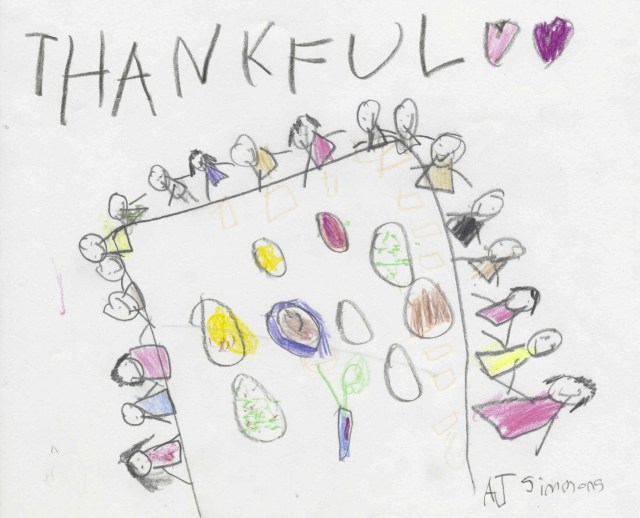
There is a place at the table for everyone.  Whether your table is set for one or 25, may your table be filled with food, joy, and hope.

(Thanks to AJ Simmons for the art.)

Posted in Uncategorized | Leave a comment

Come, You Thankful People Come

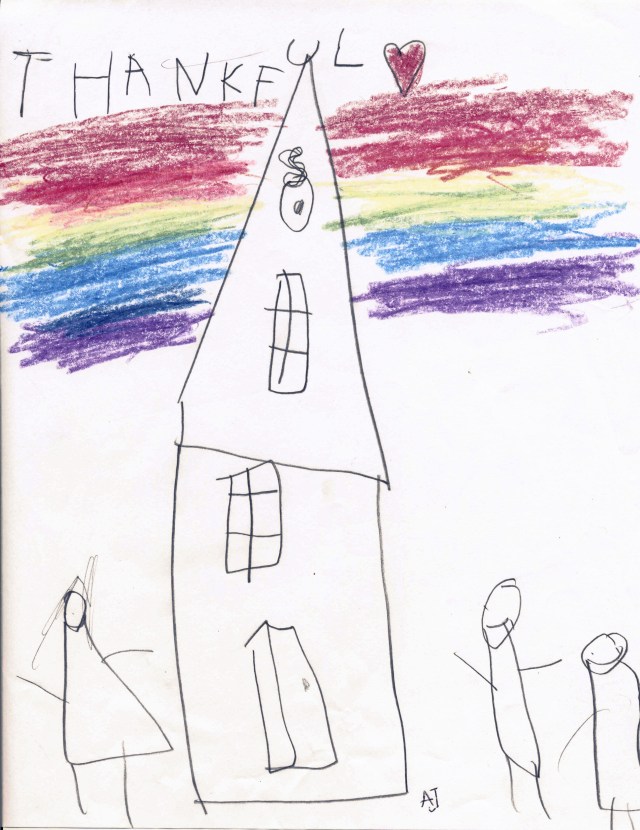
AJ Simmons drew the Broad Bay Church under the rainbow, the rainbow that scripture tells us was placed in the sky to remind God not to destroy the earth.   The rainbow is a reminder that God’s love shines on people some consider to be outcasts.

2018-11.18-Brdby-Simmons-Thanksgiving-Steeple-400dpi-Scan-1

AJ shows the people, almost larger than life.  I am grateful to be part of a church where the people stand outside the church looking outward.

For the last 6 months, we’ve raised money to maintain the church steeple and to make the building safe, flexible and accessible.   But like this picture, the focus is the people and the rainbow.   Happy Thanksgiving.

(For more information on the capital campaign visit:  Broadbaychurch.org)

Posted in Uncategorized | Leave a comment

Kavannah/Ford: Children are Watching Us

For many, painful personal issues regarding assault, sexuality, alcohol and drugs have risen to the surface.  I pray for all who remember trauma this day.  There are plenty of youth who are witnessing or participating in parties with alcohol and drugs, who have or will experience sexual assault.   I assume those youth have or will show up in church or in our families.

Our response around kitchen tables, in schools, and in church will impact whether youth come forward in hard times.  Will youth involved in actions that hurt another, reach out and share his/her regret?   Will youth who were hurt, trust that adults will hear the story, and listen with love and wisdom?

How can we respond now, in ways that invite youth to reflect with us about the issues that trouble them?   The door is open.  Can we help one another acknowledge the pain we have caused and the pain we have endured?


Posted in Uncategorized | 1 Comment

In praise of poetry and art

On Sunday, poet Elizabeth Meade, recited several of her poems in worship.  A hush fell upon the congregation as she shared these words.

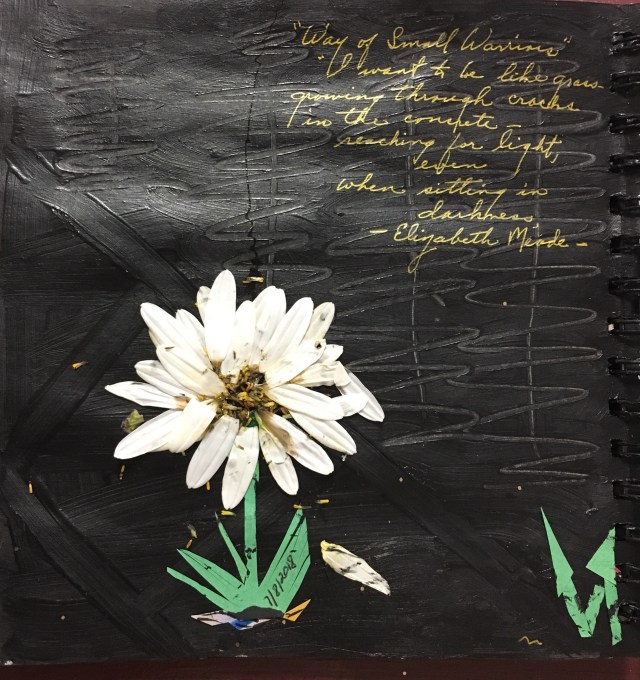
Way of Small Warriors

I want to be like grass
growing through cracks in the concrete
reaching for the light,
even
when sitting in darkness.
by Elizabeth Meade

konni.elizabeth

Konni Wells illustrated the poem.

I weep with love for all the times we are like grass pushing up the concrete.

Posted in Uncategorized | Leave a comment